Writing April 2026
The Race to the Baseline, and How to Avoid It
Most tech waves leave winners. AI adoption, for the most part, is leaving a flat field.
Originally published on LinkedIn
Most companies are using the same AI. The same handful of models, the same APIs, the same prompts, the same agentic patterns, reproduced from the same blog posts and best practices. The faster the models improve, the faster the playbook spreads, and the smaller the edge it gives any single player. If an AI lab has published a product dedicated to your field, this is great news, but not for you.
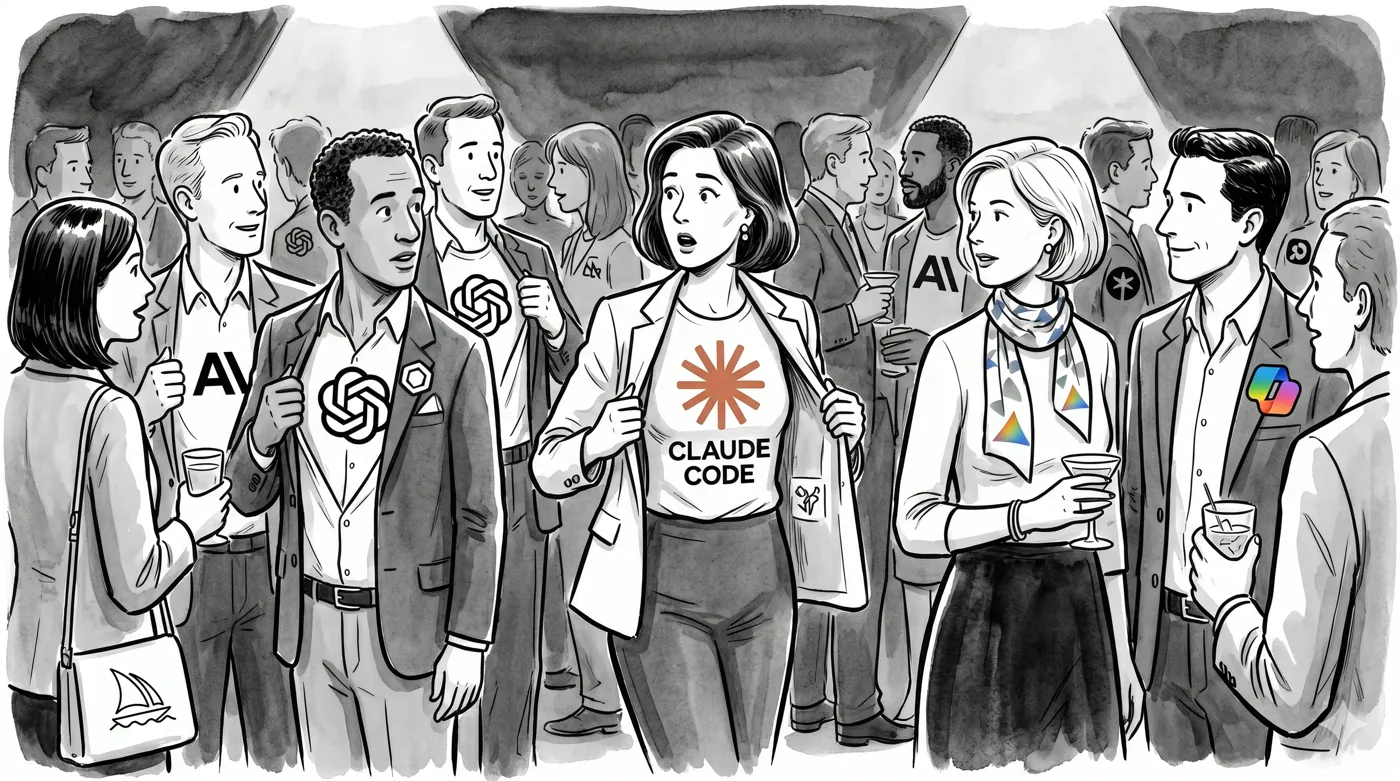
Aswath Damodaran got there early: if everybody has AI, then nobody will have AI. Treated as a tool, AI is converging into a cost line, not an advantage. The race to adopt is the race to converge. So the strategic question stops being which AI tool do we use. It becomes what AI is bolted to that nobody else can replicate. Your edge is not in the model. It is what the model is wrapped around. Wrap the model around your moat.
Before adapting AI, audit what you actually own. Not the model — anyone can rent that. Not the prompts — anyone can rewrite those. Not the harness — every team writes one. The audit is for things competitors literally cannot reach: regulated relationships, distribution partnerships, system-of-record installations that took five years to win, per-tenant data that is generated continuously by your customers’ own usage, and outcome alignment baked into how you charge. These are unevenly distributed. Most companies do not have all of them. The honest first step is to find out which you do.
Once the moat is named, the AI work has a target: shape the model to its contour. The bridge from your unfair advantage to the model is the differentiated layer. The bridge is the part that competitors cannot copy because they do not have what is on the other side.
Make the feedback loop a proprietary asset
Prompts are commodities. Eval frameworks are public. What is not public is the closed loop between your product and your customer’s behavior — the loop that decides what good means in your specific context, refreshes that definition every time a real user does something, and feeds it back into the next iteration.
This loop is harder than it sounds. It requires owning the touchpoint where the model’s output meets a human decision. It requires labeling those decisions consistently — not for the science of it, but because that labeling encodes the institutional knowledge of what your business considers a good outcome. It requires running the loop continuously, not as a quarterly evaluation exercise. If you do not own the touchpoint, this drill is in service of someone else’s moat, not yours — recognize you are playing inside someone else’s game.
Most companies skip the work. The work looks like overhead. It produces no immediate feature, but when done right, it is a moat.
A model adapted to your loop knows what your customers reward, what they tolerate, what they reject — at a granularity an off-the-shelf system cannot reach. A competitor calling the same API gets the same generic outputs. Your version, calibrated against a feedback loop only you can run, drifts further from theirs every week. Best practice is what you owe your customers. The moat is what you owe yourself.
Train for habit, not for know-how
Most upskilling programs aim at the wrong target. They teach people to write prompts and chain agents — skills that arrive in the product UI a quarter later and depreciate the moment they do.
What does not depreciate is judgment: knowing what good looks like in your domain, and catching the model when it is subtly wrong. A senior underwriter who spots a hallucinated risk factor is worth more to your AI strategy than ten engineers calling an API. Their tacit knowledge is exactly what general models lack — and exactly what the feedback loop needs as fuel.
But judgment about AI is not a discipline you teach in a slide deck. It is an experience. It has to become a habit before it can become a qualification. Serious professionals are mindful of work-product quality; they will not put something in front of a client until they trust it will hold. Give them the runway to build that trust privately.
Let them try it at home before they try it at work. Provide a budget and let your people subscribe, privately, to every credible tool on the market. People experiment more honestly, drafting a birthday toast or planning a trip, than under a colleague’s gaze. By the time AI shows up in a real deliverable, it is not a novelty — it is a tool they already know the shape of.
Then reframe the formal program around evaluation, not operation. Train people to write down why a model output was wrong, in language a downstream system can learn from. The label is the unit of work that compounds.
Distribute this fluency across functions, not into a centralized AI team. The platform team builds the rails; the moat is built by the people closest to the customer. Centralize the platform; decentralize the judgment. Hire for taste. Promote people who override the model well.
Build for the models of the future
Whatever useful tools or skills added to your model today will be absorbed by AI providers in a year (or less) and become available to everyone. Long context absorbed RAG. Native tool calling absorbed agent frameworks. Memory will absorb half of the personalization. Whatever clever workaround you ship this quarter is on a release-note timer.
The point is not to be first to use AI. By the time you read this, that race is over, and the leaderboard is flat. The point is to use AI in a shape no one else can.
That shape is the flywheel. Better insights make customers better operators. Better operators generate richer data. Richer data feeds the loop that produced the insights and a better product. Customers benefiting from it are unlikely to leave — and the model trained inside this flywheel pulls further from the off-the-shelf one every quarter, in directions a competitor renting the same API will never see.
If you liked this, you might also like
AI Will Not Make You Cool
The pattern of AI-powered irrelevance.
Read the essay