Writing January 2026
AI Will Not Make You Cool
The pattern of AI-powered irrelevance.
Originally published on LinkedIn
We tend to use new tools to pursue old desires. AI finally lets us build the website we've always wanted, launch the product that's been living in our heads for years, and ship the experience we never had the resources to execute properly. It feels like progress — and in isolation, it is. But while the supply side just became dramatically easier, the demand side didn’t pause to wait. It quietly moved on.
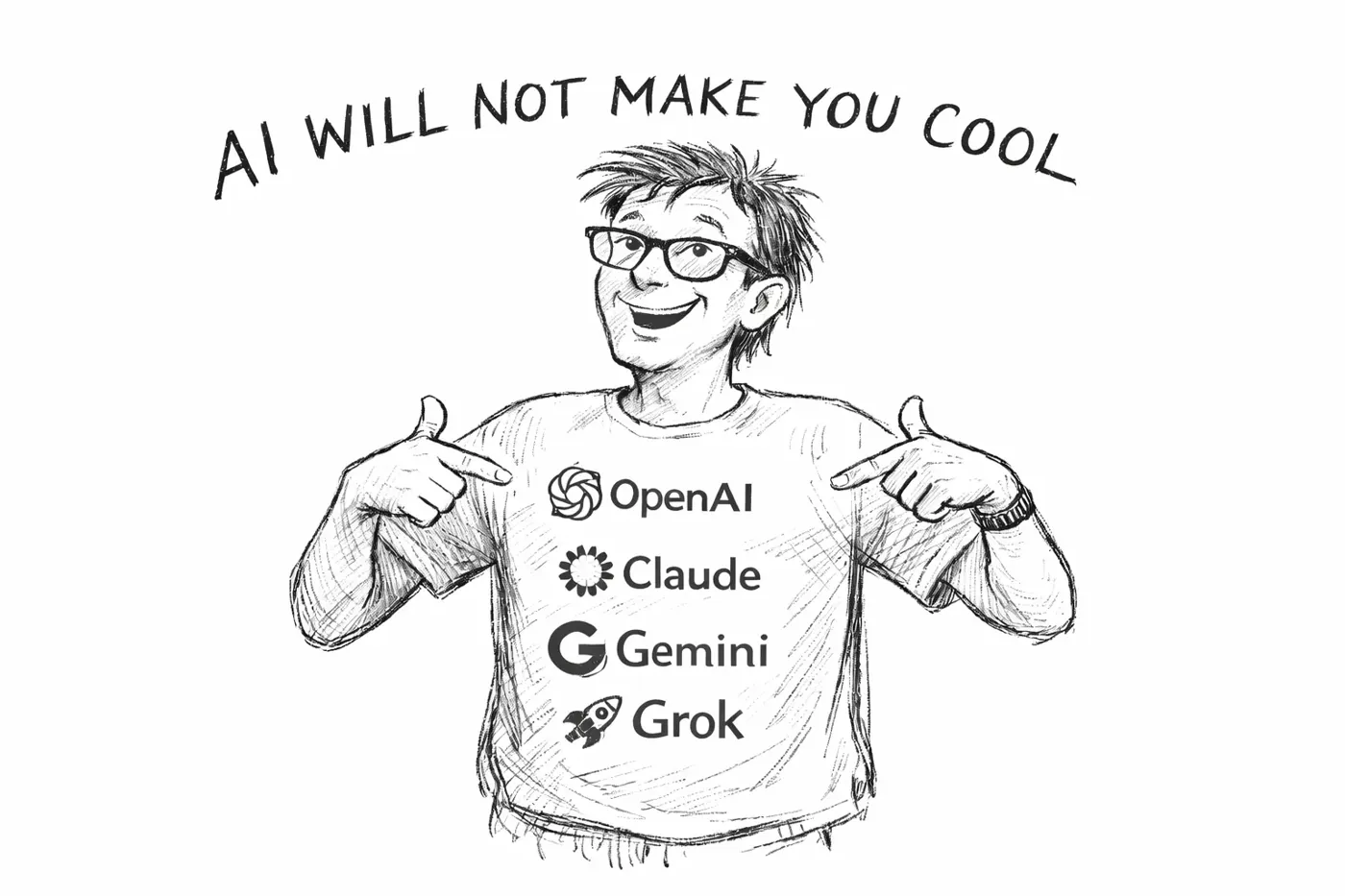
You can already see this happening in concrete ways. People are using AI to set up dropshipping stores, content sites, newsletters, micro-products, and personal brands — utilizing playbooks that were effective a few years ago. Execution has never been easier. And yet many of these projects stall almost immediately. Not because they’re poorly made, but because the requirements for product-market fit have shifted. The market is more saturated, discovery works differently, trust is harder to earn, and attention is increasingly mediated. AI made the old plan executable just as the environment that rewarded it changed.
There’s a structural shift underneath all of this. People still want information, services, and solutions — but they increasingly encounter them indirectly; Less browsing, less wandering, more delegation. When someone asks an AI to find a gift or compare options, they’re not landing on your homepage. They’re receiving a compressed answer that may or may not reference you, and probably doesn’t link to you at all.
This changes what “being discovered” even means. The old game assumed humans were the ones doing the looking. If the looking gets outsourced, what you build is no longer consumed by people lingering on a page — it’s filtered by systems acting on their behalf. That doesn’t eliminate demand. But it reframes which supply gets noticed and which gets skipped.
Even when humans are still the ones consuming directly — without agents in between — something subtle is already breaking. For a long time, we relied on intuition to judge quality: aesthetics, polish, attention to detail. Consciously or not, we treated these as proxies for care, competence, and trust. That intuition worked when those signals were expensive. In an AI-saturated world, they’re cheap. When every website looks great, when every product page is clean, articulate, and well-designed, those cues stop differentiating and start misleading. Human attention doesn’t disappear — it drifts toward other signals: authenticity, specificity, friction, even imperfection. It wouldn’t be surprising if rough edges start to feel more trustworthy, not because they’re better designed, but because they’re harder to fake.
There’s a comforting belief underneath much of today’s AI enthusiasm: that once you can finally build the thing you always wanted to build, the market will reward it. That belief used to be mostly true. Today, it’s fragile. New tools don’t make old ideas future-proof; they just make them easier to execute — often, a little too late.
What makes this pattern costly isn’t dramatic failure. It’s quiet waste. Thoughtful work gets built, polished, and shipped, and then dissolves into the background. No backlash, no rejection — just indifference. That’s harder to diagnose than failure and easier to misinterpret. The danger isn’t building the wrong thing; it’s investing real care into something whose moment has already passed.
AI doesn’t create a loophole around risk. It removes friction, and in doing so, it exposes irrelevance faster. If using AI feels comfortable — if it fits neatly inside the way you already think about value — it’s worth pausing. Creating for a future that hasn’t fully arrived yet has always been uncomfortable. That part didn’t change.
Here’s the thing worth holding onto: the problem you cared about probably still matters. The frustration that sparked your idea, the gap you wanted to close — those don’t expire the way solutions do. What expires is the particular form you imagined.
Don’t abandon the problem. Abandon your attachment to the solution that finally became easy to build. Somewhere ahead of where you’re standing is a version that fits the world as it’s becoming, not the world that just ended. That version will be harder to see and less satisfying to execute because it hasn’t been validated yet, because the playbook doesn’t exist, because it requires you to be early rather than finally on time; AI won’t make that part easier, that’s your part. [The End]
P.S. This piece was not written out of foresight; it was discovered on my rearview mirror, and this is my old desire, website — www.getspines.com

If you liked this, you might also like
When “Good Enough” Becomes the Gold Standard
AI, efficiency, and the quiet drift toward mediocrity.
Read the essay