Writing July 2025
Same Same But Different
What we can learn about AI from previous paradigm shifts, and what we can’t.
Originally published on LinkedIn
Professionals and organizations have lived through paradigm shifts before. We’ve adapted to the internet. We’ve reorganized around mobile-first. We’ve overhauled marketing, operations, and customer service to fit social platforms. So it’s only natural that many companies are now dusting off the same innovation playbook. They’re back in REORG mode, trying to map this next wave of disruption — AI — onto familiar frameworks.
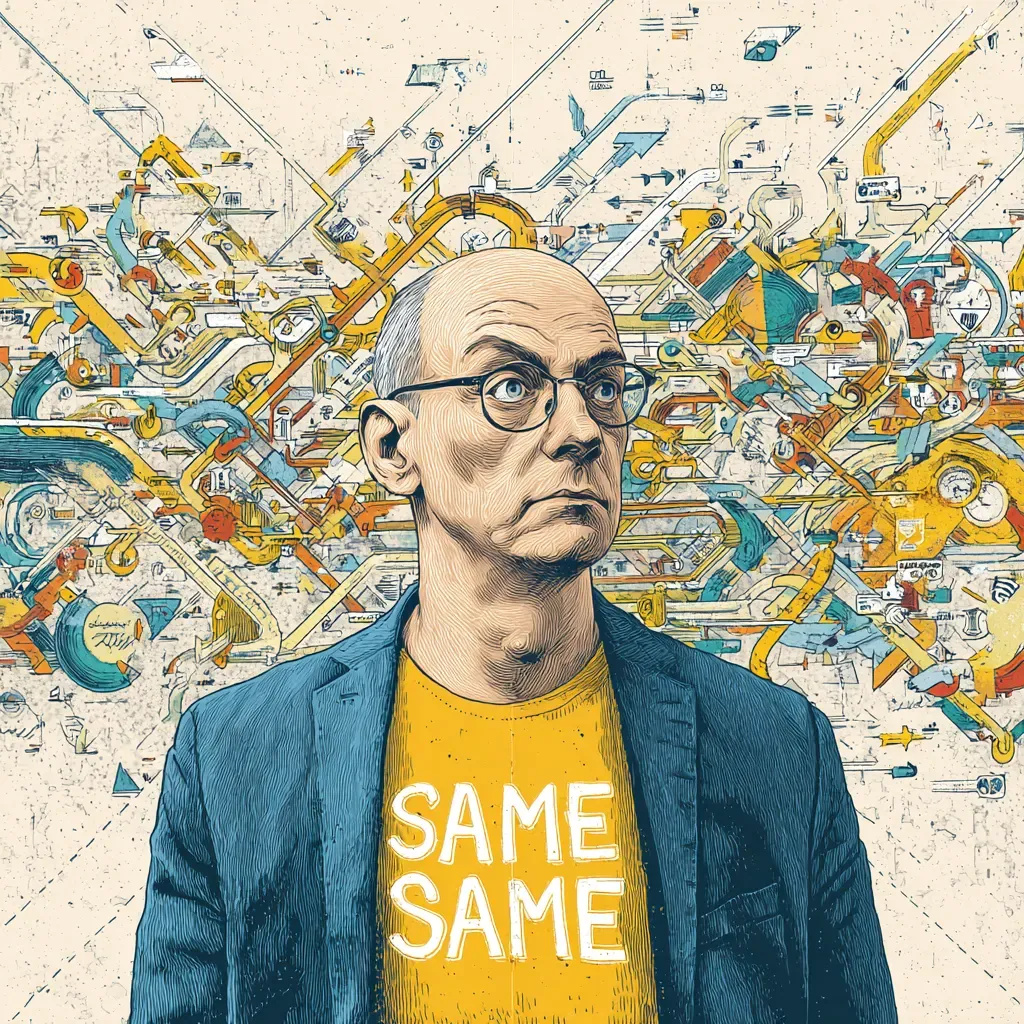
But this wave is different, and it’s not even the real wave yet. What we’re seeing now is just a modest ripple moving ahead of something much larger: a not-yet-defined, system-wide AI tsunami. And the tactics that helped organizations survive previous tech shifts may be dangerously misaligned with what’s coming. What if, theoretically speaking, while you’re trying to harness AI to outpace your competitors… you’re missing the fact that AI itself is your new competitor? Or what if there is no new normal beyond this shift, and everlasting shifts are the new normal…like the ever-changing planet of Cybetron. Attention is all you need to realize that the Transformers were born on Earth.
We’ve seen platform shifts before, and we have seen failed attempts to innovate during the transition. Entire companies were built around gaps in Facebook or LinkedIn and delivered the “missing features”, just to wake up one day and realize the platform had rolled out a native function that made them irrelevant. We’ve seen the same play out with AWS absorbing the functionality of countless devtools. And we have already seen the same within Gen-AI, 2023 cohort startups working on prompt-induced chains-of-thoughts, trying to solicit more profound outputs from LLMs — woke up one day to hear about a native deep research capability, and 2024 cohort of agentic workflows generators.. as if this is not already baking within the platforms.
What’s happening with foundation models is not just another platform cycle. It’s not just a new infrastructure layer or a shiny interface. This wave introduces something we’ve never dealt with before: a system that brings intelligence, not just functionality. Models are not only expanding in capabilities — they’re learning how to do what used to require human judgment. They write code, improve themselves, plan, and increasingly operate with agency. It’s not just technology getting better. It’s cognition entering the stack.
The companies now racing to build tools and wrappers on top of foundation models must know this. Many of them are fully aware that the jobs they’re doing — prompt orchestration, workflow chaining, thin UI wrappers — are temporary. But they’re betting that staying active, visible, and integrated during this chaotic phase will give them the strategic position they need to adapt when the dust settles (if ever). Their goal isn’t just product-market fit. It’s long-term relevance in a space that hasn’t defined its boundaries yet.
That makes everything more uncertain, especially for companies that are adopters rather than builders.
If you’re a logistics firm, a hospital, or a financial institution, you’re now being told that AI is critical to stay competitive. But what does that mean in practice? Should you adopt a chatbot? A copilot? A retrieval-augmented tool? A fine-tuned vertical model? The surface is unstable. What looks like a high-value tool today might collapse into the core model tomorrow. We’ve already seen this with prompting tools, agent frameworks, and RAG pipelines — early signs of opportunity that quickly became obsolete as model providers integrated the same capabilities natively.
For most companies, this creates a bind. Wait too long, and you fall behind. Move too fast, and you risk wasting time, money, and credibility on something temporary. The metaphors we’re working with — prompts, chains, orchestrators — might turn out to be transitional scaffolding, like paper-mimicking websites in the early web. Meanwhile, foundation models are evolving into something that interacts not with people, but with other systems and agents. The future interface may not be designed for humans at all, but for intelligent actors operating on our behalf.
This is why companies need to treat AI adoption differently. They should bias toward flexibility and modularity. They should avoid tools that only make sense in today’s narrow interpretations of what AI is. They should evaluate vendors not just on current features, but on how exposed they are to being overwritten by the next model release.
And most importantly, they should acknowledge that this is not just a new software cycle. It’s something more profound: a shift from a tool-driven world to an intelligence-driven one. That changes the rules.
Maybe AI is not something you adopt, but rather something you become.
If you liked this, you might also like
Weapons of Mass Extraction
How AI chatbots became the most effective cognitive miners in human history.
Read the essay